
Meet our Fall 2025 Alumni Spotlight
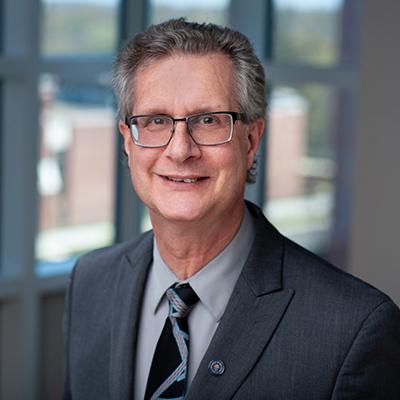 Michael Rossi, Ph.D.
What is your connection to the Department of Biology?
I earned my Ph.D. from the Department of Biology in 1990. My work was under the supervision of Dr. Sheldon Steiner, and it was looking at the role of eicosanoids in myoblast fusion and differentiation. My work was heavily based on cell culture and biochemistry. As such, it gave me a chance to use a broad variety of technical skills.
What was your overall experience with the department? When I look back at the classes, graduate school was easy. I love the chance to explore different opportunities doing research rotations in my first year. Every one of the labs I was rotated through was exciting. I often think I only picked Shelly’s lab because his was the final rotation and I could just keep going with my rotation project. As Dr. Philip Bonner would say, “when you have choices, it isn’t really possible to make a rational decision. You just need to pick one and move forward.” My choice worked out very well for me.
What is your current (or most recent) career role/position/title? How did you get to this position? How has this role made a positive impact on your community?
I became the associate dean for the College of Art & Sciences at the University of New Haven in 2014. I served in that role until my retirement in July 2025 with a brief stint during Covid as the interim dean. It was my data skills, the ability to work across disciplines and with difficult people that got me the appointment in the first place. I had experience as a program coordinator, department chair and time as the assistant dean.
Morale hasn’t always been high in Arts and Sciences. Across the nation, Colleges of Arts & Sciences feel under attack, and it was no different at New Haven. The emphasis on return on investment for students is not always clearly described in discussing CAS programs. I was highly data driven to demonstrate how each of our units created long-term growth for the students at the University. This included the ones that majored in our college and those that just took the general education courses were offered. Added to that, I developed strong relationships with each of the chairs and as such was able to support and promote each department. My openness, even when I was telling people we couldn’t do what they wanted, led to a level of trust that helped counter other morale issues.
What do/did you like most about your position? What was most challenging?
I really liked becoming invested in all the programs in the college, not just biology. My background was interdisciplinary, so getting to see all the great things the students and faculty were doing across our college was very satisfying.
The most challenging thing I had to do was schedule classes for the college. We offered about 60% of the undergraduate classes, and it took a lot of planning to make sure the courses students were going to need were offered in a timely manner and not have courses that needed to be taken together at conflicting times. The university grew a lot over the years, so we hit a point of tight classroom availability that further complicated this task.
What are some important skills that have served you well through your career?
Data analysis and good notebook keeping may not sound like much, but they were the items that really mattered in most of what I did. Being able to clearly show in simple terms what the data mean is always important. Record keeping as basic as that sounds is not something everyone is good at. If you stay in the lab or move on to administration, however, the skill is critically important.
Any advice for students who want to work in the same field as you?
I specifically chose to go to a smaller, teaching institution. Two things that really helped was my time as a TA at UKY and paying attention to the curriculum that both the undergraduate and graduate programs used. It allowed me to create an M.S. program in cellular and molecular biology as well as introduce a number of significant curricular changes at the undergraduate level. It allowed me to develop a reputation as someone that was able to get projects done.
Secondly, I always looked for opportunities to grow. Sometimes this was because I actively sought them out; other times it was because they just came to me. The move to the dean’s office came to me without my looking for it, because of my reputation. It wasn’t even on my radar before the dean called me.
Do you have any mentors or professors who significantly impacted your life? How so?
The two most significant people for me at the University of Kentucky were Sheldon Steiner and Philip Bonner. Shelly gave me the opportunity to develop my research interests and follow them. He was a tough advisor, but he made sure I stayed on tract with my work. Phil was a mentor in a philosophical and emotional sense. When I was stressed out, he was the one I would talk to.
What was one of your favorite classes and why?
The Cellular Biology class was the best course I took. It was a two-semester series taught by multiple instructors and really forced me to think about data interpretation and how experimental design impacted that interpretation.
Describe any highlights or memorable moments here in biology/UK that most influenced you.
The first time I had data that clearly demonstrated difference in eicosanoid metabolism between differentiation competent and fusion defective mouse myoblasts, I remember running down the third floor of the TH Morgan building shouting. It had taken several months of work to get this and it proved to be a breakthrough in my dissertation project.
This isn’t related to the department per se, but we were in the lab working and listening to the radio (Shelly always had NPR or classical music going) when they broadcast the launch and subsequent explosion of the Challenger space shuttle. It was very traumatic.
Any overall advice for current students?
Always look for opportunities for growth. You never know what you will learn and how it may impact your future career.
Develop strong communication skills and make sure you are always treating others with respect. This will lead to a support network as you advance in your career.
What are your interests outside of work?
Well of course I have my three grandsons. I get to enjoy them now more due to my recent retirement.
In public service, I am active in town politics. Specifically, I have been on the Planning and Zoning Commission in my town for 25 years and just started another four-year term.
At the educational level, I have two projects that I am continuing since retirement. The University of New Haven Prison Education program in collaboration with the Yale Prison Education Initiative brings the opportunity for incarcerated individuals to earn an associate or bachelor’s degree. We are at a high security men’s prison and a low security women’s facility. I helped develop the initial curriculum for the programs and am continuing wo work for way to support the students.
I am also working with a company that offers first-semester or first-year study abroad experiences. The courses are accredited by the University of New Haven, and I help with new initiatives.
Why do you support the Biology Student Success Fund?
I feel it is important that all students have the chance to participate in research. For many lack of support means they need to work second jobs rather than get time in the lab. I want to do what I can to eliminate that inequity.