
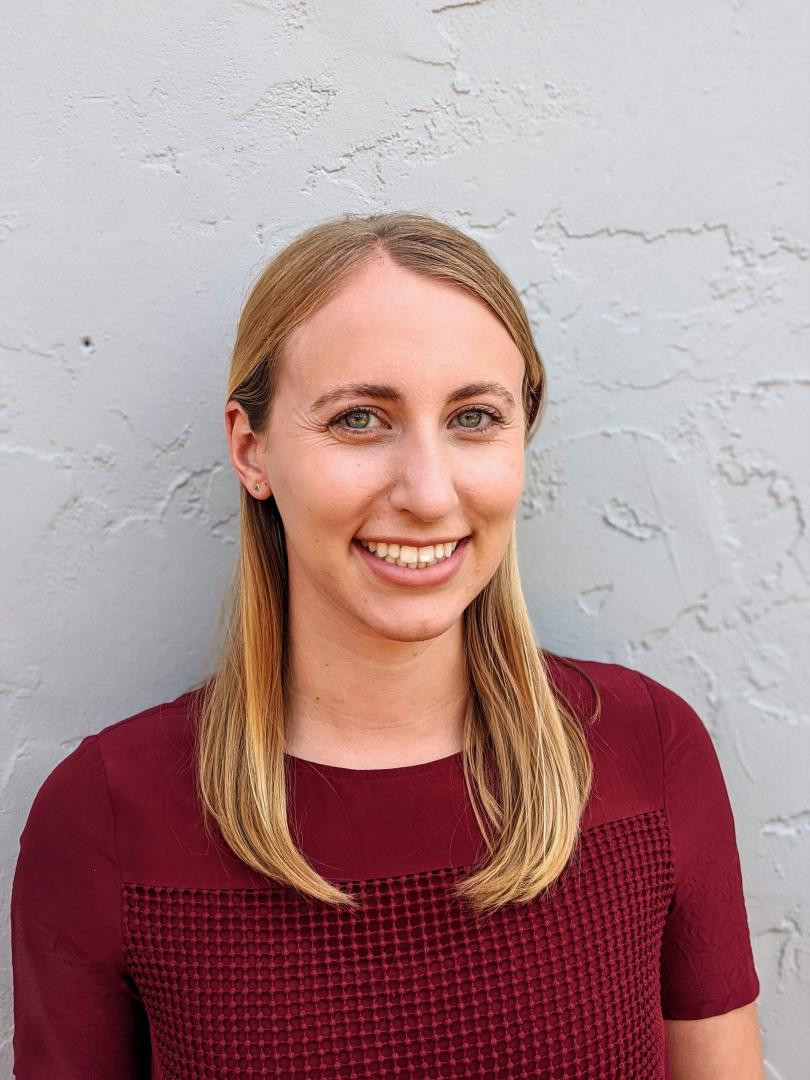
 Dr. Alexandra Long | Long Lab
How long have you been with the department?
I started in the department in January 2025, so I have been here almost a year.
What motivated you to come to our department?
I was excited about the diversity of questions, approaches, and model systems in this department. It is a great place to do interdisciplinary work on a non-traditional model system.
Where did you live before starting at UK?
I moved from the bay area in California, where I was for graduate school and my postdoc, but I am originally from Massachusetts.
What are you most proud or excited about?
I am so excited about getting the lab up and running and so proud of my lab for fearlessly jumping in to work on an emerging model system where we are building a lot of protocols from the ground up.
What draws you to your work?
I am fascinated by the puzzle of understanding how cells work. I find it endlessly interesting that across the tree of life cells use similar networks of cytoskeletal polymers to form different shapes and structures and power complex behaviors like swimming, dividing and crawling.
What is your favorite part of your job?
I love looking at microscopy images with my group and puzzling over what they might be telling us about how biological systems work. I can spend all day happily doing just this.
What is the most challenging part of your job?
It is both exciting and challenging to work on a system where there are a lot of questions but not as many tools as in other models. This type of research requires a lot of troubleshooting and patience for techniques that are usually considered routine.
What’s your favorite course to teach and why? If this is your first semester teaching, what will you be teaching and what do you like about that subject?
I am teaching cell biology next semester, which I am thrilled about. I love being able to take students on a journey into the inner workings of a cell and dig into the foundational experiments that teach us about how cells work. I also think it is a great opportunity to explore the beauty and complexity of cells and hopefully convince students they are more than just "building blocks" of tissues.
Tell us about your research interests and why you are passionate about them. Is this something you’ve been working on throughout your career or has it changed over time?
My lab studies the cytoskeleton, specifically microtubules and the different structures (e.g. centrosomes, spindles, cilia) that cells build out of microtubules and remodel throughout their lifecycle to perform different functions (e.g. intracellular trafficking, dividing, signaling, swimming). We use a nontraditional system to do this: chytrid fungi, which retain a complex microtubule cytoskeleton that was lost in the rest of fungi (think yeasts, mushrooms, etc.). I think this system offers a great opportunity to learn about cell biology from an evolutionary perspective, since we can compare different chytrid species to each other and to other fungi and animal cells. Chytrids also remodel their cytoskeleton rapidly over a short, synchronous lifecycle, so they are a great system for studying many different remodeling events in a short time. I am very excited by the intersection of cell biology, biophysics and evolutionary biology, and in my lab we try to combine these different perspectives to understand these fundamental cellular rearrangements in the chytrid lifecycle.
Is this something you’ve been working on throughout your career or has it changed over time?
I have been really fascinated by these topics ever since I was an undergraduate when I happened one term to take Cell Biology and Evolution at the same time. I read a beautiful review paper from Bill Wickstead and Keith Gull on the evolution of the cytoskeleton that had just come out, and I was hooked. I went on to study the mechanics of cell division in mammalian cells as a graduate student, and then for my postdoc I wanted to work on a system that was unicellular and would allow for more evolutionary comparisons, so I began working on centrioles and cilia in chytrid fungi, which is the model we are continuing to work with now in my group.
What do you want the public to know about your research?
I think it is often hard for the general public to connect with cell biology because it can be tricky to envision things that are microscopic. I want the public to know that we have a powerful toolkit to see and probe how cells build and rebuild their internal cytoskeleton to make the correct structures for each cell type and stage. If you have a problem with your house, you want to hire a contractor who knows a lot about how a house is built to come fix it. We need to understand the fundamental principles that underly how different cells are built if we want to be able to fix them when they malfunction in different diseases like cancer and ciliopathies (e.g. polycystic kidney disease).
What do you consider to be your greatest achievement in your career?
I am really proud of the students that I have mentored and taught who are continuing on in science and medicine. Doing research can be really challenging, and it is so rewarding for me to see students grow and advance our frontiers of knowledge. I hope that the impact I have in my career is not only in my own research group’s efforts to increase our understanding of the rules of cellular organization, but to nurture the next generation of scientists, teachers, and health professionals who are empowered to ask and answer new questions and explain how biological processes work.
What is something that you wish others (students, colleagues) knew about what you do?
I was trained as a biophysicist. I often wish that people would think more about the physics of biological systems. For example, the cytoskeleton is not only a network inside the cell but a self-organized polymer system that both generates piconewton forces and has to withstand them in order for a cell to properly function.
If you could share one piece of advice with students, what would it be?
I would recommend finding multiple mentors. At any stage, whether you are a first semester undergraduate or a senior graduate student, it helps to get the perspectives of different people. Your instructors, teaching assistants, postdocs, senior students, etc., are great resources and sounding boards for what classes to take, how to get involved in research, how to think about career choices, etc. Take advantage of our friendly department community and reach out.
How do you spend your free time?
I spend most of my free time these days outside with my two kids and my dog exploring different parks in the Lexington area.
If you weren’t a biologist, what would you be doing?
I would be an elementary school teacher.
If you could only eat one food for the rest of your life, what would it be?
Definitely chocolate.
If you could meet one famous person, dead or alive, who would it be and why?
I would have to say Thomas Hunt Morgan. I have been learning so much more about him since starting in this department, and he seems like he had such an interesting journey in science. I would love to hear what he would think about the way we as a field are approaching biology these days.
Is there another question we could be asking in an interview like this?
I would love to know: what sparks people’s creativity? What do they do when they are seeking inspiration?