
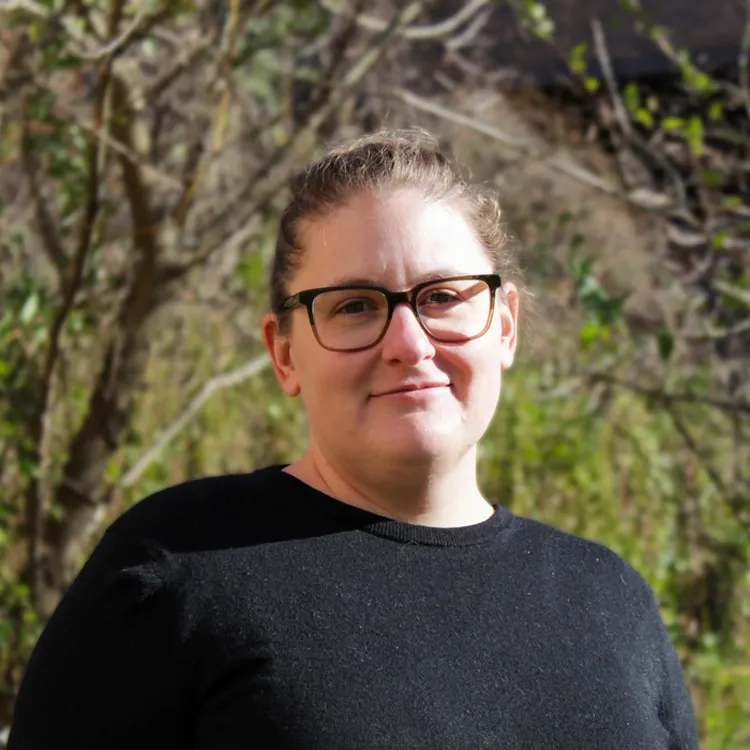
 Dr. Brittany Belin
Bio:
Dr.Brittany Belin is a graduate of Notre Dame (B.S., biochemistry & philosophy) and the University of California San Francisco (Ph.D., bBiophysics), where she studied the actin cytoskeleton using quantitative microscopy, cell biology and computational analysis. For her postdoc work, she transitioned to studying plant-bacteria symbiosis at Caltech, and she opened her own lab studying lipid biophysics in plant-bacteria symbiosis at the Carnegie Institution for Science in 2020. She is interested in symbiosis and microbial cell biology in all of its forms, and she loves learning and teaching about emerging models for studying these topics.
Abstract:
Life is powered by fixed carbon and nitrogen, and the exchange of these elements is a common basis for bacteria-eukaryote symbioses. The Bradyrhizobia are a globally dominant soil bacteria that form nitrogen-carbon exchange symbioses with peanuts, soybeans and other legumes, and work in our lab and others has shown that these symbioses require cholesterol-like bacterial lipids known as hopanoids.
The mechanisms through which hopanoids participate in symbiosis are not clear, but our preliminary data suggest that hopanoids:
- Participate in the early stages of the B. diazoefficiens-legume interaction by promoting bacterial motility and signal secretion.
- Regulate bacterial membrane biophysics in a manner similar to that of cholesterol in animal cells.
These findings suggest a fundamental connection between bacterial membrane biophysics and successful host-microbe interactions that likely is mediated by diverse, membrane-rigidifying “secondary lipids” throughout the bacterial domain of life.