
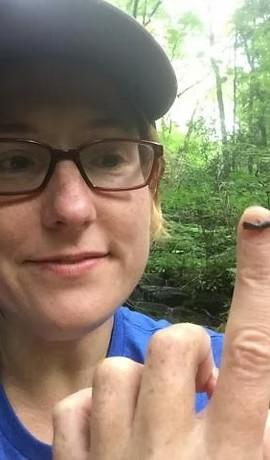
 Dr. Mary Foley
Bio:
Mary Foley is a postdoctoral researcher in biology education at Middle Tennessee State University. She received her undergraduate degree in biology from the University of Kentucky. She earned a master’s degree in microbial biology from Rutgers University, where she studied the function of the YlaN protein in Staphylococcus aureus. She earned her Ph.D. from the University of Kentucky, where she performed microbiome research under David Weisrock and Luke Moe.
During that time, she also began her journey in biology education research under Jennifer Osterhage, which motivated her to pursue a postdoc in biology education. Over her academic career, she has taught a range of undergraduate biology courses, including introductory biology, microbiology and research-based lab courses. She has recent experience teaching a large introductory biology lecture. Her teaching focuses on helping students build confidence and a sense of belonging in biology through active engagement with the material, by connecting the course material to real-world issues and by practicing effective science communication.
Abstract:
My research journey reflects a sustained interest in biology, spanning biological systems and how undergraduate biology students learn science. My training as a bench biologist, conducting molecular microbiology and microbiome research, provided extensive experience in experimental design and data analysis, as well as firsthand exposure to the nature of scientific inquiry. Through teaching undergraduate research courses as a graduate student, I became increasingly interested in the distinction between the skills needed to succeed in a science class and those required to succeed in science more broadly. This realization led me to transition into biology education research, where I currently examine how undergraduate research experiences and science communication activities influence students’ motivation and science identity.
My research background directly informs my teaching. Drawing on both my disciplinary and educational research, I design courses that emphasize skills such as data interpretation, science communication and critical thinking alongside core biological concepts, while promoting curiosity, resilience, and reflection, skills I believe are necessary for both success in science careers and improving society through science. My teaching demonstration reflects this approach through learning goals that include tracing the transformation of energy and matter through photosynthesis, explaining how pigment structure enables light capture, evaluating the biological origin of plant biomass in the context of climate change mitigation and practicing effective dialogue around climate change.