
 Dr. Lynn Martin | Martin Lab
Bio:
Dr. Lynn B. Martin is a professor of global, environmental and genomic health sciences in the College of Public Health at the University of South Florida. He earned his B.S. and M.S. in biology from Virginia Commonwealth University and completed his M.A. and Ph.D. in ecology and evolutionary biology at Princeton University, followed by postdoctoral training in psychology and neuroscience at The Ohio State University.
His research focuses on physiological ecology, disease ecology and ecological epigenetics, with an emphasis on how organisms respond to environmental change. Much of his work uses wild vertebrates — especially birds and small mammals — to understand how variation in immune function, hormones and gene regulation shapes health, host competence and adaptation in natural populations.
Abstract:
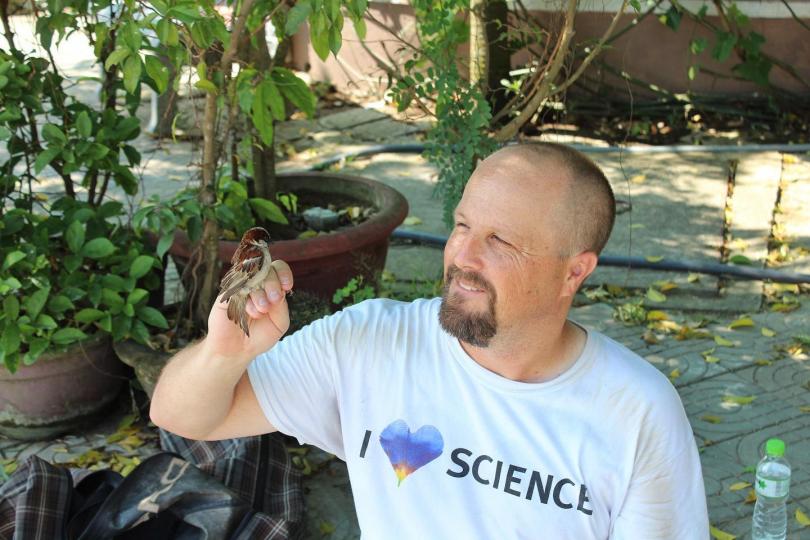
Why do some populations colonize new areas whereas others fail? This question is becoming more and more important to answer as we continue to change the planet. For about two decades, my lab has been studying how one of the world’s most common species, the house sparrow, has achieved its success. Whereas we have considered a variety of behavioral and physiological mechanisms, we are finding that one epigenetic process, namely the regulation of gene expression via DNA methylation, was particularly important. In this talk, I’ll present highlights of our current work on how the interplay of foraging behavior, infection with gut pathogens and physiological defenses has enabled some birds to found new populations and hence colonize many parts of the world.